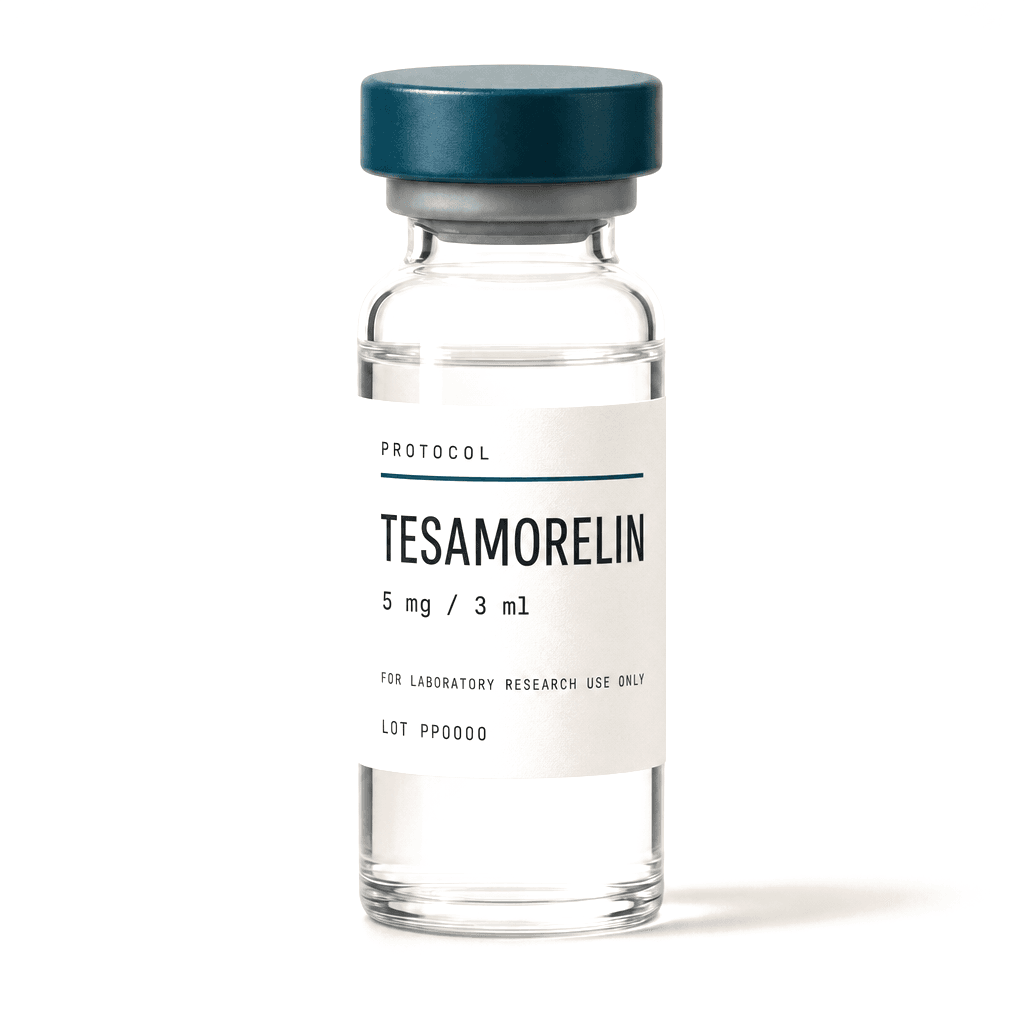
Tesamorelin
Growth Hormone Secretagogues
£42.00per vial
Awaiting batch
This vial is sealed for the protection of health and hygiene. Under regulation 28(1)(e) of the Consumer Contracts (Information, Cancellation and Additional Charges) Regulations 2013, the 14-day right to cancel is lost for this item once that seal is broken. While the seal is intact the right applies in full.
Tesamorelin cannot be listed to research users in Australia, Canada, Japan, Mexico, New Zealand, Norway, Russian Federation, Saudi Arabia, Singapore, South Korea, Switzerland, United Arab Emirates. Verify local eligibility before ordering.
Tesamorelin is a synthetic analogue of human growth hormone-releasing hormone, GHRH(1-44), carrying a trans-3-hexenoyl group on the N-terminal tyrosine that slows dipeptidyl peptidase-4 cleavage. It binds the GHRH receptor on pituitary somatotrophs and is catalogued for in-vitro and preclinical work on GH-axis signalling, IGF-1 pathway activity, and visceral adipose tissue models.
Also known as TH9507.
For laboratory research only. Not for human consumption. No medical claims. This product is not intended to diagnose, treat, cure, or prevent any disease.
- UK DISPATCH
- TRACKED SHIPPING
- COA ON RELEASE
- SECURE PAYMENT
Compound details
Tesamorelin is a synthetic analogue of human growth hormone-releasing hormone, GHRH(1-44), carrying a trans-3-hexenoyl group on the N-terminal tyrosine that slows dipeptidyl peptidase-4 cleavage. It binds the GHRH receptor on pituitary somatotrophs and is catalogued for in-vitro and preclinical work on GH-axis signalling, IGF-1 pathway activity, and visceral adipose tissue models.
Tesamorelin is a 44-amino-acid GHRH analogue. The structural difference from endogenous GHRH is a trans-3-hexenoyl moiety attached to the N-terminal tyrosine, which is the residue DPP-4 attacks in the native molecule. That modification extends the half-life in plasma and in serum-containing culture media, which is the reason the analogue rather than native GHRH is used where exposure has to be sustained across an assay window.
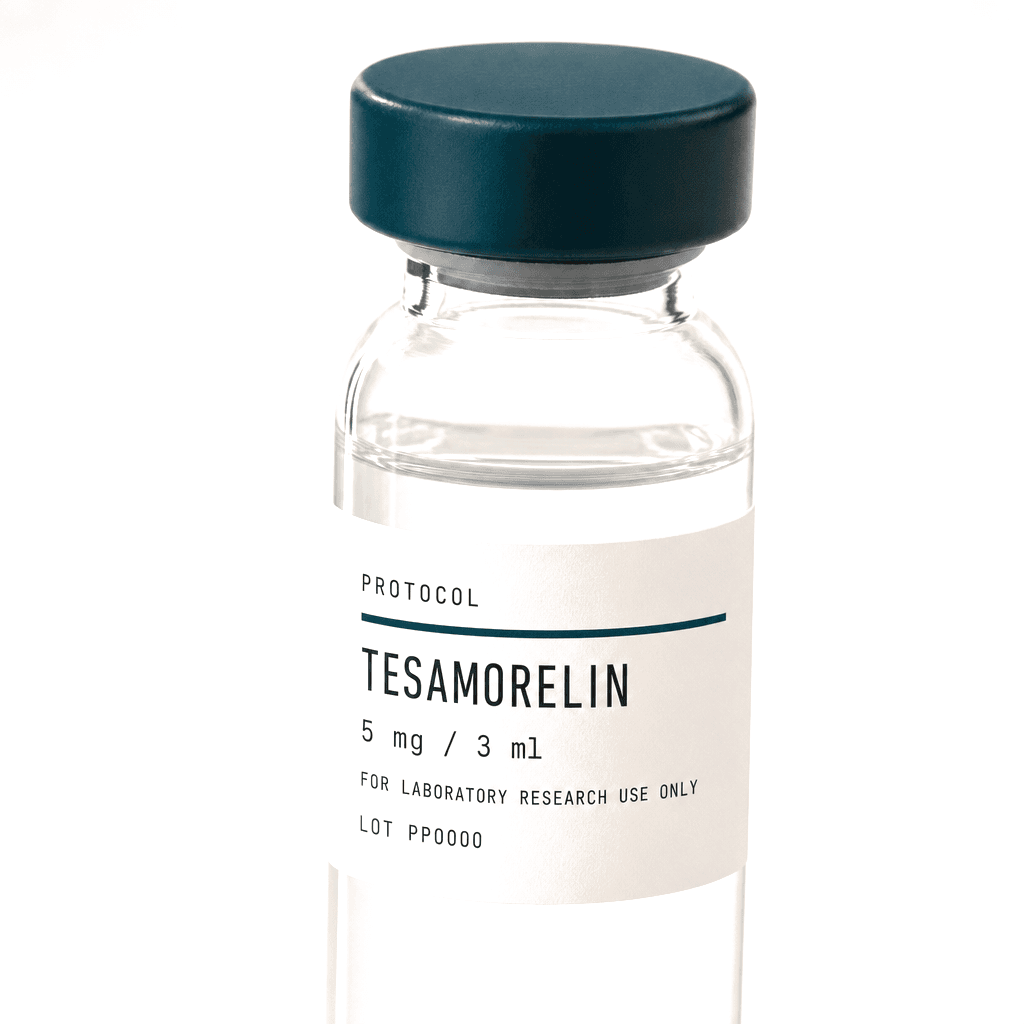
- Molecular weight
- 5136 g/mol
- Sequence
- trans-3-hexenoyl-YADAIFTNSYRKVLGQLSARKLLQDIMSRQQGESNQERGARARL-NH2
- Presentation
- Sealed 3ml vial
Molecular weight source: PubChem CID 16137828. View the PubChem record
Tesamorelin is a 44-amino-acid GHRH analogue. The structural difference from endogenous GHRH is a trans-3-hexenoyl moiety attached to the N-terminal tyrosine, which is the residue DPP-4 attacks in the native molecule. That modification extends the half-life in plasma and in serum-containing culture media, which is the reason the analogue rather than native GHRH is used where exposure has to be sustained across an assay window.
The receptor is GHRHR, a class B G protein-coupled receptor expressed on anterior pituitary somatotrophs. Agonist binding couples through Gs to adenylyl cyclase, raises intracellular cAMP, activates protein kinase A, and drives CREB phosphorylation and Pit-1-dependent transcription of the GH1 gene. The output is pulsatile rather than tonic growth hormone release, and preserving that pulsatility is the reason GHRH analogues are studied separately from direct growth hormone administration in endocrine models.
Downstream, growth hormone acts at hepatic GHR to drive JAK2/STAT5 signalling and IGF-1 transcription, so IGF-1 concentration is the usual distal readout in these models. Controlled laboratory research has examined tesamorelin in models of the hypothalamic-pituitary-somatotropic axis, in visceral adipose tissue remodelling and lipolysis models, and in lipodystrophy models. It is also used as a pharmacological tool to separate GHRH-receptor-mediated effects from ghrelin-receptor-mediated effects when compared against GHRP-class secretagogues. No therapeutic, diagnostic, or clinical conclusion is drawn from any study referenced above, and none should be inferred.
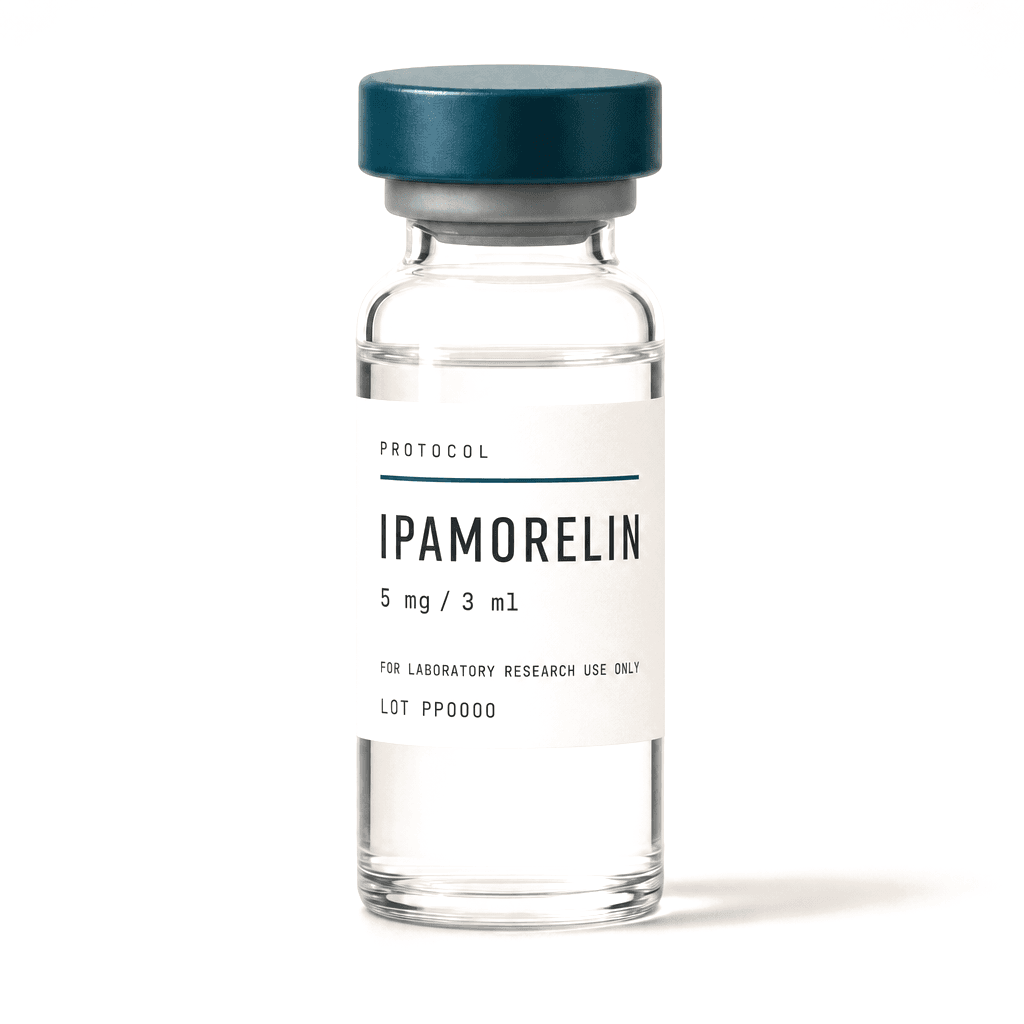
Tesamorelin is listed in a sealed 3ml vial, at 5mg and 10mg.
When a batch is released, it is independently analysed before it is listed. Purity is measured by high-performance liquid chromatography, which resolves the truncation and deletion sequences that a 44-residue peptide is prone to. Identity is confirmed by mass spectrometry against the expected mass. Those are the two analytical methods used, and no other method is claimed.
When a batch is released, the batch number on the vial resolves to the public Certificate of Analysis for that batch, reporting the compound, the lot reference, the HPLC result, the mass-spectrometry result, the analysis date. The document is published before the batch enters the catalogue. Specimen documents on this site are for demonstration only and are not genuine laboratory reports.
When a batch is released, it is independently analysed by HPLC and mass spectrometry before it is listed, and the Certificate of Analysis for that batch is published in full, including the measured purity figure for that batch.
Tesamorelin
TS5605Specimen record. Not a genuine laboratory report.
| PARAMETER | METHOD | RESULT |
|---|---|---|
| Purity | HPLC | 97.6% |
| Identity | Mass spectrometry | Consistent with expected mass |
HPLC
Purity by chromatography
ON RELEASE
MASS SPECTROMETRY
Identity confirmation
ON RELEASE
PUBLIC COA
Each released batch number resolves to its Certificate of Analysis
COMMITTED
Research Use Only
Tesamorelin is catalogued strictly for in-vitro laboratory research. It is not for human consumption, veterinary use, or therapeutic, diagnostic or clinical application. It is not supplied as a medicinal product and it is not licensed by the MHRA.
Not a Medical Product
None of the compounds listed on this site are medicinal products, nor should they be marketed, described or used as such. No medical claims are made about Tesamorelin. Nothing on this page is medical, veterinary or scientific advice, and no guidance on preparation, administration or quantity is provided or will be provided on request.
Compliance and Responsibility
The research user is responsible for ensuring compliance with all laws and regulations governing the receipt, handling, storage, use and disposal of research chemicals in their jurisdiction, and for applying appropriate control measures under the Control of Substances Hazardous to Health Regulations 2002 or the equivalent local regime.
Analytical Scope
When analytical results are published for Tesamorelin, they relate solely to the batch identified on the Certificate of Analysis. Two methods are used: high-performance liquid chromatography and mass spectrometry. No other analysis is performed or implied. Results for one batch do not warrant any other batch. Specimen documents are for demonstration only and are not genuine laboratory reports.
Jurisdiction Notice
Tesamorelin cannot be listed to research users in the following jurisdictions: Australia, Canada, Japan, Mexico, New Zealand, Norway, Russian Federation, Saudi Arabia, Singapore, South Korea, Switzerland, United Arab Emirates. It is the research user's responsibility to verify local eligibility before placing an order. Where an order is placed for a jurisdiction in which the compound cannot be listed, the order will be cancelled and refunded in full.
Every released batch has a document.
The Certificate of Analysis for a batch is published when that batch is released. Your batch number then resolves to the report. Specimen documents on this site are for demonstration only.
For laboratory research only. Not for human consumption. No medical claims.